

EveShop
Turkey's first production Shopify Hydrogen storefront for a nationwide cosmetics retailer, paired with mobile commerce delivery.
Role
Lead Developer / Frontend Team Lead at Machinarium
Industry
Cosmetics and personal care retail
Context
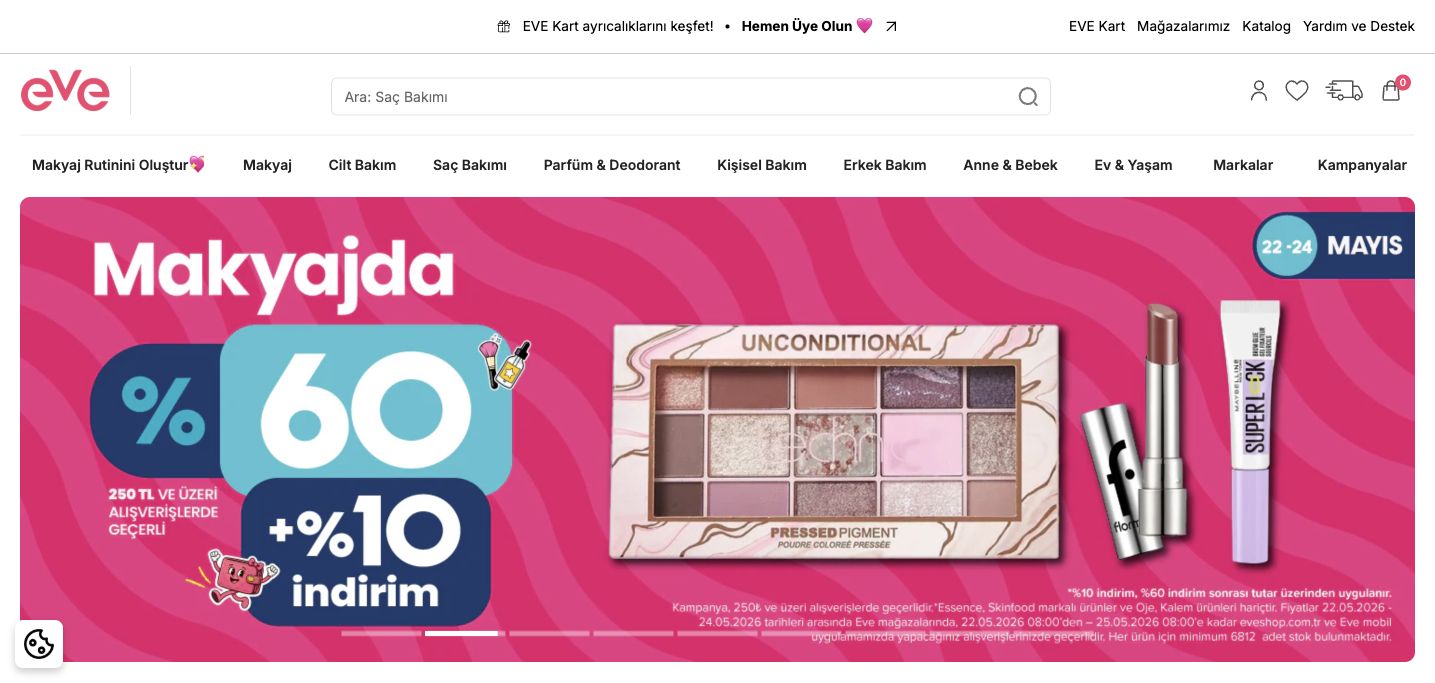
EveShop large-scale Shopify Hydrogen + mobile commerce case study
A national beauty and personal care retailer needed a storefront and mobile-adjacent commerce foundation that could support retail-scale catalog browsing, campaign traffic, and a production ecommerce operation rather than a small experimental headless build.
Problem
EveShop is a nationwide cosmetics and personal care retailer that opened its first store in April 2015 and launched ecommerce roughly 1.5 years later. By the time this Hydrogen work started, the business was serving a large retail footprint, a broad catalog across beauty and personal care, and a documented audience context of 400K+ web users plus 100K+ mobile users. The storefront had to support digital-first shoppers, campaign traffic, and customers moving between physical stores, the site, and mobile commerce without making merchandising feel chaotic. In practical terms, the pressure was not just page speed. It was how to present a high-SKU catalog cleanly, keep browsing understandable, and give the team a storefront surface that could handle enterprise-like retail complexity without collapsing into theme-level compromise.
My responsibility and approach
As lead developer and frontend team lead at Machinarium, I worked on the Hydrogen web storefront alongside the React Native mobile apps. The operator lesson at large-catalog production scale was to keep senior technical decisions close to delivery: establish reusable frontend and component standards, mentor the team, and apply those patterns across campaign pages, category browsing, and commerce flows instead of accumulating one-off patches.
Constraints
- Large retail catalog with many browsing paths and campaign moments.
- Need for reusable frontend patterns across ecommerce and mobile-adjacent work.
- Production launch expectations for a nationally visible storefront.
- Long-term value depended on the organization continuing to maintain a custom storefront.
Technical decisions
- Use Shopify Hydrogen, React, Remix, TypeScript, GraphQL, and GTM-backed tracking patterns documented in the broader project stack.
- Create stable frontend patterns instead of one-off campaign or category patches.
- Keep the storefront architecture focused on commerce readability, product discovery, and team maintainability.
SEO and performance risks
- High-SKU catalog pages needed crawlable, understandable product and category content.
- Campaign traffic required predictable routes and stable page behavior.
- A custom storefront needed ongoing ownership so performance and SEO did not degrade after launch.
Implementation
What shipped and why it mattered.
Production delivery paired senior-led architecture and GraphQL Storefront API decisions with reusable component standards, component-level implementation, and frontend mentoring across the Hydrogen storefront and related React Native work.
Result
EveShop launched a production Hydrogen storefront for its national retail operation, alongside React Native mobile commerce work. Reusable frontend patterns supported the broad beauty and personal care catalog. Maintaining that custom storefront remains an ongoing operational responsibility.
Production Shopify Hydrogen experience on a nationally visible retail storefront.
Hydrogen web storefront delivery alongside React Native mobile commerce work.
Reusable frontend patterns for a broad cosmetics and personal care catalog.
Screenshots
Visual proof
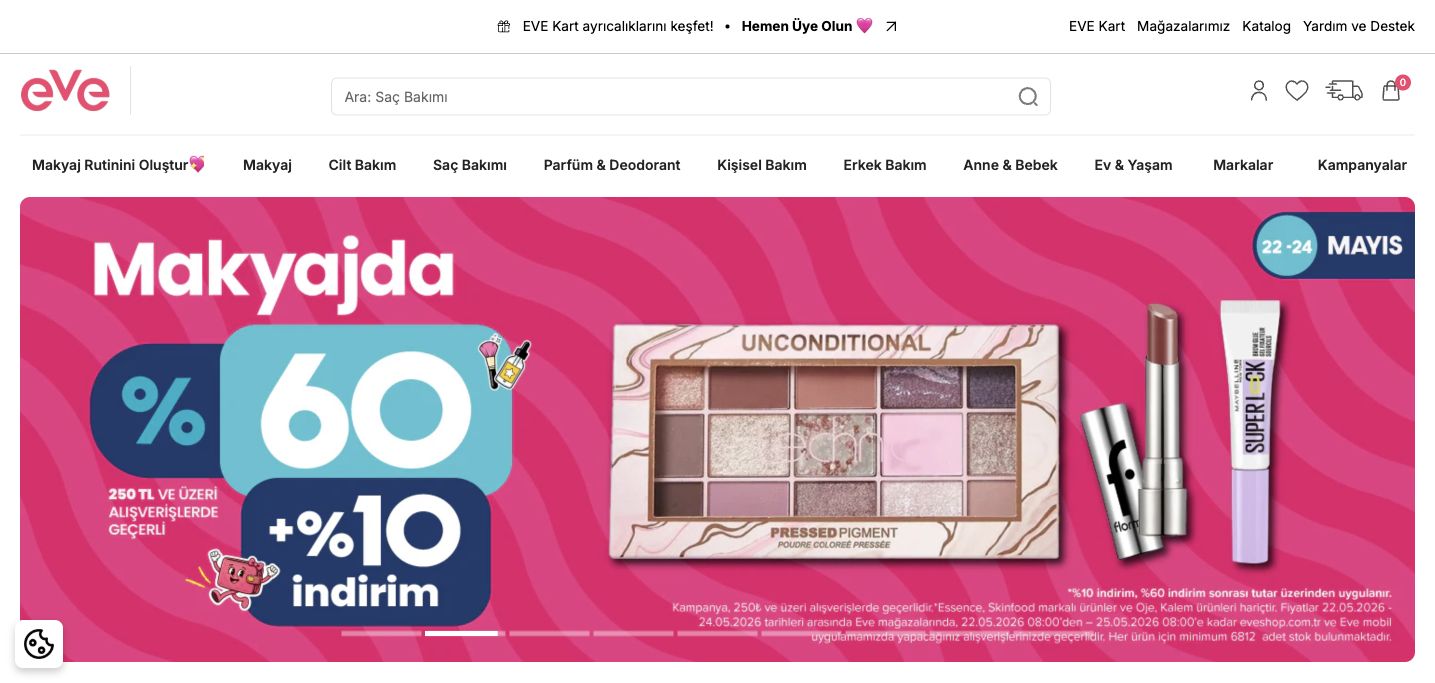
Project audience context
Documented audience scale for the project, not a before-and-after growth measurement.
Web users
400K+
Mobile users
100K+
Tech stack
What the implementation sat on
Is this relevant to your store?
Custom / Enterprise Hydrogen proof
Lead Developer / Frontend Team Lead at Machinarium across Shopify Hydrogen, React, React Native, Remix, TypeScript, GraphQL, GTM.
Need a leaner version of this? View Hydrogen packages from $2K-$5K.Relevant paths